
Physics A Level | Chapter 20: Ideal gases 20.4 Boyle’s law
This law relates the pressure p and volume V of a gas. It was discovered in 1662 by Robert Boyle.
If a gas is compressed at constant temperature, its pressure increases and its volume decreases. A decrease in volume occupied by the gas means that there are more particles per unit volume and more collisions per second of the particles with unit area of the wall. Because the temperature is constant, the average speed of the molecules does not change. This means that each collision with the wall involves the same change in momentum, but with more collisions per second on unit area of the wall there is a greater rate of change of momentum and, therefore, a larger pressure on the wall.
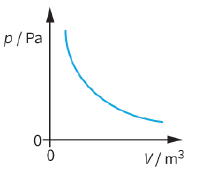
Pressure and volume are inversely related.
We can write Boyle’s law as:
The pressure exerted by a fixed mass of gas is inversely proportional to its volume, provided the temperature of the gas remains constant.
Note that this law relates two variables, pressure and volume, and it requires that the other two, mass and temperature, remain constant.
Boyle’s law can be written as:
$p \propto \frac{1}{V}$
or simply:
$pV = Constant$
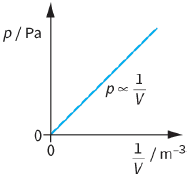
We can also represent Boyle’s law as a graph, as shown in Figure 20.5. A graph of p against $\frac{1}{V}$ is a straight line passing through the origin, showing direct proportionality.
|
|
For solving problems, you may find it more useful to use the equation in this form:
${p_1}{V_1} = {p_2}{V_2}$
Here, ${p_1}$ and ${V_1}$ represent the pressure and volume of the gas before a change, and ${p_2}$ and ${V_2}$ represent the pressure and volume of the gas after the change. Worked example 1 shows how to use this equation.
Question
6) A balloon contains $0.04\,{m^3}$ of air at a pressure of $120 kPa$. Calculate the pressure required to reduce its volume to $0.25\,{m^3}$ at constant temperature.